Availability Heuristic: Definition, Examples & How to Avoid It
If a plane crash leads the news, flying suddenly feels more dangerous — even though nothing about the actual odds changed. That’s the availability heuristic: judging how likely or common something is by how easily examples of it come to mind, rather than by the real numbers. It’s one of the most useful mental shortcuts we have, and one of the most reliably wrong, and the research behind it turns out to be stranger than the simple version most explainers give you.
What is the availability heuristic?
The availability heuristic (pronounced uh-vay-luh-BIL-uh-tee hyoo-RIS-tik) — also called the availability bias — is a mental shortcut where people judge the probability or frequency of something based on how easily examples come to mind, rather than on actual data. If examples are easy to recall — because they’re vivid, recent, or emotionally charged — the mind treats that ease as evidence the thing itself is common or likely.
It was identified and named by psychologists Amos Tversky and Daniel Kahneman in 1973, as part of the broader research on judgment heuristics that later won Kahneman a Nobel Prize. It belongs in our cognitive biases guide alongside anchoring bias and the Dunning-Kruger effect as one of the shortcuts that quietly substitutes an easy question (“what comes to mind quickly?”) for a harder one (“what’s actually true?”).
As a field, it sits inside cognitive psychology and behavioral economics — the study of how people actually judge probability under uncertainty, rather than how classical theory assumed they should. In terms of theory, it belongs to Tversky and Kahneman’s heuristics-and-biases research program, later folded into Kahneman’s dual-process account of thinking: a fast, automatic System 1 that hands back whatever comes to mind easily, and a slower, effortful System 2 that could check the answer but often doesn’t bother to.
The original 1973 studies
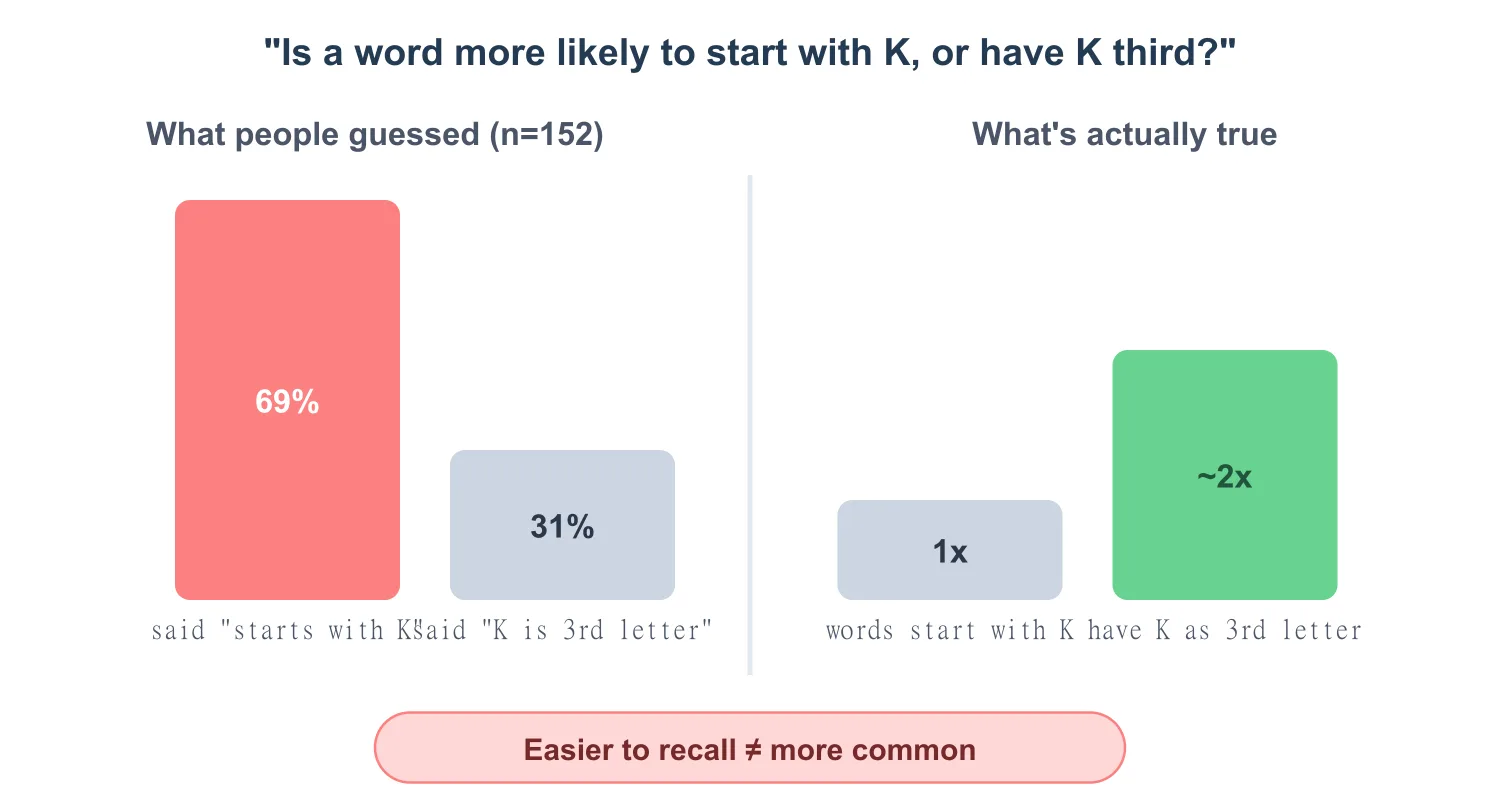
Tversky and Kahneman’s foundational paper, “Availability: A Heuristic for Judging Frequency and Probability,” ran several experiments to demonstrate the effect. The most famous asked people a simple question: in English text, is a random word more likely to start with the letter K, or to have K as its third letter?
About two-thirds of participants — roughly 105 of 152 people tested — guessed that words starting with K are more common. They’re wrong, and not by a small margin: words with K in the third position actually outnumber K-starting words by roughly two to one. The reason for the mistake is exactly the mechanism the study was probing — it’s easy to rattle off words that start with K (kite, kitchen, kangaroo), and genuinely effortful to think of words where K sits third (ask, joke, bike). That difference in retrieval effort, not the real frequency, drove people’s answers.
A related experiment in the same paper asked people to estimate the result of two multiplication problems shown for a few seconds each: 1 × 2 × 3 × 4 × 5 × 6 × 7 × 8 versus 8 × 7 × 6 × 5 × 4 × 3 × 2 × 1 — mathematically identical, just written in opposite order. People who saw the descending sequence guessed a far higher final number than people who saw the ascending one, because the large numbers that came to mind first anchored their estimate.
The ease-of-retrieval twist: a stranger, better-supported finding
Here’s the part almost every short explainer skips. In 1991, researchers Norbert Schwarz and colleagues ran a study that complicated the simple “more examples come to mind, so it feels more common” story — and the result is more interesting than the original.
Participants were asked to list examples of times they’d behaved assertively. One group had to list 6 examples — easy for almost anyone. Another group had to list 12 — genuinely difficult for most people. Afterward, everyone rated how assertive they actually considered themselves to be.
The result ran backward from what a simple “availability = more examples = stronger belief” model would predict: the people who listed 12 examples rated themselves as less assertive than the people who only had to list 6 — even though the 12-example group had objectively generated twice as much supporting evidence for their own assertiveness. The same reversal showed up with unassertive behavior.
Schwarz’s explanation: what drives the judgment isn’t the raw count of examples you can produce, it’s how easy that production felt. Struggling to reach 12 examples sent its own signal — “this must not be my strong suit if it’s this hard to think of cases” — and that signal outweighed the actual content of the list. The availability heuristic, in other words, runs on the felt difficulty of retrieval, not the retrieved material itself.
Availability vs. representativeness heuristic
These two are easy to blur together because Tversky and Kahneman introduced both as part of the same research program on judgment shortcuts.
- Availability heuristic: judging frequency or likelihood by how easily examples come to mind.
- Representativeness heuristic: judging probability by how much something resembles a typical case or stereotype, regardless of actual base rates.
Both are heuristics in the technical sense Tversky and Kahneman meant it: fast, usually-useful mental shortcuts that substitute an easier question for a harder one, and that produce predictable, systematic errors when the substitution misleads.
Availability heuristic examples
Availability heuristic examples in real life
- Shark attacks vs. air travel risk: Shark attacks receive heavy, vivid media coverage, so people often rate them as a bigger threat than statistically more common causes of harm during travel or beach trips. The often-cited comparison — that falling airplane parts have historically killed more people than sharks — has itself been challenged with more recent data, which is a fitting irony: even the go-to example of the availability heuristic has been shaped by which statistic is easiest to recall.
- Local crime perception: Neighborhood safety apps that push frequent crime alerts have been shown to inflate people’s sense of how much crime is happening nearby, even when actual crime rates haven’t changed — every notification is a fresh, easy-to-recall example.
- Investing after a downturn: A Franklin Templeton investor survey found that in the years following the 2008 financial crisis, many investors believed the stock market had performed far worse than it actually had — the vivid memory of the crash outweighed the calmer, less memorable years of recovery that followed.
- Health risk perception: People with a friend or family member who had a specific illness often rate their own risk of that illness as higher than their actual risk factors justify — a personal, easily-recalled case feels like stronger evidence than statistics ever do.
- Lottery ticket purchases: Widely publicized jackpot winners make winning feel more available and therefore more likely, even though the odds haven’t moved at all.
At work
A manager who recently dealt with one employee’s late report may rate the whole team as unreliable, because that one vivid, recent incident is far easier to recall than the dozens of reports that arrived on time.
In the classroom
Research on course evaluations found that students asked to list a small number of criticisms (an easy task) rated a course more harshly than students asked to list many criticisms (a hard task) — mirroring the same ease-of-retrieval reversal Schwarz found with assertiveness.
In the courtroom
Mock-juror studies have found that testimony given more recently in a trial is often judged as more truthful or more deceptive than earlier testimony, simply because it’s fresher and easier to recall during deliberation.
In hiring
An interviewer who recently had one bad experience with a candidate from a particular background may unconsciously weight that one memorable case more heavily than years of unremarkable, positive experience with candidates from the same background.
In marketing
Advertisers lean on the availability heuristic directly: repeating the same ad until a brand name is the first one that comes to mind, surfacing recent five-star reviews on a product page instead of the full rating history, or citing a high-profile data breach to make a security product feel more urgently necessary than the underlying risk justifies. None of these tactics change the real odds — they just make one outcome easier to recall than the alternatives.
How to avoid the availability heuristic
- Ask for the base rate, not the anecdote. Before trusting a vivid example, look up the actual statistic it’s supposedly representative of.
- Notice when something feels obviously true because it’s just recent. Recency and truth are not the same thing — a fresh memory isn’t automatically a representative one.
- Be skeptical of your own certainty after media coverage. A story you saw covered five times didn’t necessarily happen five times more often than a story you saw once.
- Remember the ease-of-retrieval trap works both ways. If someone struggles to list many examples supporting a claim, that struggle itself can — correctly or not — make the claim feel weaker. Separate how hard something was to recall from whether it’s actually true.
- Actively seek disconfirming examples, the same habit that helps against confirmation bias — deliberately asking “what am I not thinking of?” counteracts the tendency to treat whatever’s already in mind as the whole picture.
This connects to the broader critical thinking skill of checking intuitive judgments against actual evidence, rather than trusting whatever example surfaces first.
Frequently asked questions
What is the availability heuristic in simple terms?
It’s the tendency to judge how common or likely something is based on how easily examples of it come to mind, rather than on actual data. Vivid, recent, or emotional examples feel more common than they really are.
Who discovered the availability heuristic?
Psychologists Amos Tversky and Daniel Kahneman identified and named it in their 1973 paper “Availability: A Heuristic for Judging Frequency and Probability,” including the famous study showing people wrongly believe words starting with K are more common than words with K as the third letter.
What is the difference between the availability heuristic and the representativeness heuristic?
The availability heuristic judges frequency by how easily examples come to mind. The representativeness heuristic judges probability by how much something resembles a typical case or stereotype. Both were introduced by Tversky and Kahneman as part of the same research on judgment shortcuts.
What is an example of the availability heuristic?
Overestimating the danger of shark attacks because of heavy media coverage, while underestimating statistically more common risks that receive less vivid reporting, is a classic real-world example.
How do you avoid the availability heuristic?
Check actual base rates and statistics instead of relying on recalled examples, be skeptical of judgments formed right after heavy media coverage, and deliberately look for examples that contradict your first impression.
Does thinking of more examples always strengthen a belief?
No — research by Norbert Schwarz found the opposite can happen. When people struggled to generate a large number of examples, the difficulty itself made them trust the underlying belief less, even though they’d technically produced more supporting evidence.
How do you pronounce “availability heuristic”?
Uh-vay-luh-BIL-uh-tee hyoo-RIS-tik. “Availability” stresses its fourth syllable (“BIL”), and “heuristic” stresses its second syllable (“RIS”).
What branch of psychology is the availability heuristic part of?
It falls under cognitive psychology and behavioral economics — specifically the heuristics-and-biases research program Tversky and Kahneman built to study how people judge probability and frequency under uncertainty.
Is the availability heuristic the same as availability bias?
Yes. “Availability heuristic” and “availability bias” describe the same concept: the heuristic is the mental shortcut itself, and the bias is the systematic error it produces when that shortcut misfires.
How is the availability heuristic used in marketing?
Marketers make an outcome or product feel more common or urgent by keeping it easy to recall — through repeated advertising, surfacing recent reviews and testimonials instead of a product’s full track record, or highlighting a dramatic recent event. The underlying facts don’t change, only how easily an example comes to mind.
How do you overcome the availability heuristic?
The same way you avoid it: check actual base rates instead of trusting recalled examples, notice when a judgment is really just driven by something recent or vivid, and deliberately look for counterexamples. See the “How to avoid it” section above for the full list.
Keep learning: the full list of cognitive biases, how anchoring bias distorts judgment in a related way, and the Dunning-Kruger effect for another case where confidence and accuracy pull apart.