Critical Thinking Exercises: 15 Practical Ways to Sharpen Your Mind
Critical thinking isn’t a talent you’re born with — it’s a set of habits you build through practice. The exercises on this page are the same techniques used in boardrooms, classrooms, hospitals and intelligence agencies to cut through noise, expose hidden assumptions and reach better decisions. Each one comes with a plain-English explanation, a worked example, and a link to a full deep-dive guide.

What are critical thinking exercises?
Critical thinking exercises are structured mental routines that force you to slow down and examine how you’re thinking, not just what you’re thinking. Instead of accepting the first answer that pops into your head, you deliberately question assumptions, weigh evidence, consider alternatives and check your reasoning for errors.
The skill underneath them all is the ability to analyze and evaluate information objectively before forming a judgment. If you’ve ever made a snap decision you later regretted, you’ve felt what happens without it. These drills build the opposite habit — they make deliberate reasoning automatic.
How to practice critical thinking (the right way)
A few ground rules make every exercise below far more effective:
- Use a real problem. Abstract puzzles are fine for warming up, but the skill transfers best when you apply it to a decision you actually face.
- Write it down. Thinking “in your head” hides gaps in your logic. Writing exposes them.
- Separate the question from the answer. Spend more time defining the problem than solving it — most bad decisions come from solving the wrong problem.
- Invite disagreement. Your reasoning is only tested when someone (or some technique) pushes back on it.
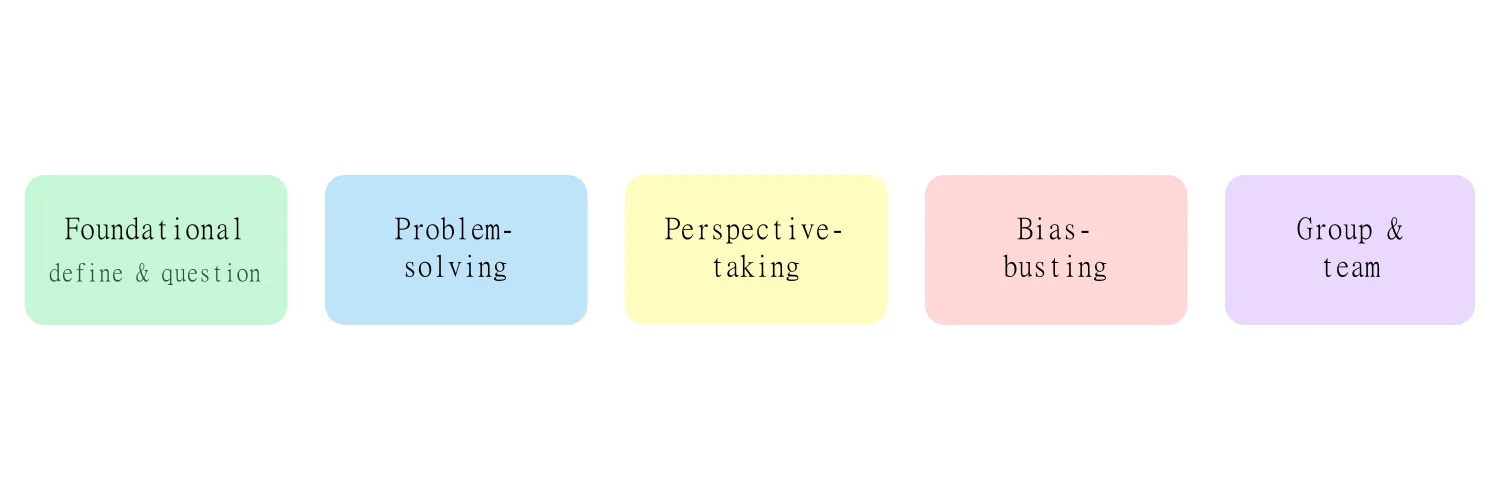
Foundational exercises
1. The 5 Whys
Ask “why?” five times in a row to drill past symptoms to the real root cause of a problem. Each answer becomes the subject of the next “why.”
2. Socratic questioning
Interrogate a belief with a fixed set of questions: What do I mean by this? What’s my evidence? What am I assuming? What’s the counter-example? How might I be wrong?
3. Fact vs. opinion sorting
Take any article or argument and label each statement as a verifiable fact, a reasoned inference, or an opinion. The exercise reveals how often persuasion smuggles opinion in as fact — a core media-literacy skill for students.
Problem-solving exercises
4. Inversion
Instead of asking “how do I succeed?”, ask “how would I guarantee failure?” — then avoid those things. Inversion surfaces risks that forward-thinking misses. It’s a cornerstone of the mental models toolkit — read the full inversion thinking guide →
5. First-principles thinking
Strip a problem down to facts you know are true, then rebuild a solution from scratch instead of reasoning by analogy (“we’ve always done it this way”).
6. Argument mapping
Diagram a claim, its supporting reasons, and the evidence under each reason. Seeing the structure visually makes weak links — and logical fallacies — obvious. Read the full argument mapping guide →
Perspective-taking exercises
7. Six Thinking Hats
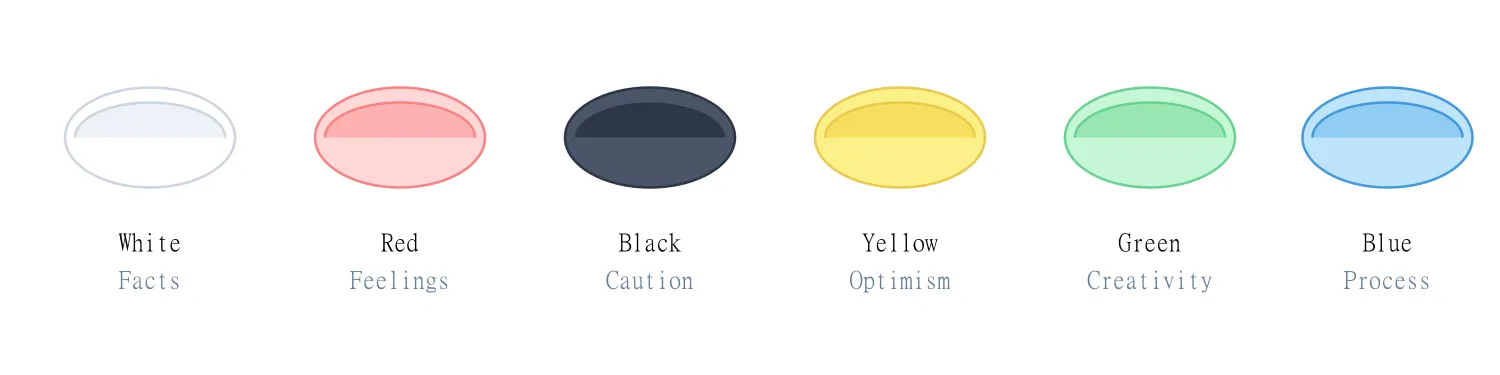
Edward de Bono’s method: examine a decision from six fixed angles in turn — facts (white), feelings (red), caution (black), optimism (yellow), creativity (green), and process (blue) — so a group explores every dimension instead of arguing past each other.
8. Steel-manning
Before you criticize an opposing view, restate it in its strongest form — so well that its holder would say “yes, that’s exactly what I mean.” Only then respond. The opposite of a straw man.
9. Devil’s advocate
Deliberately argue against the group’s favored option to stress-test it before committing. Formalized, this becomes red teaming.
Bias-busting exercises
10. The pre-mortem
Imagine your project has already failed spectacularly. Write the story of why. This sidesteps optimism bias and surfaces risks people are too polite to raise in a normal planning meeting.
11. Consider the opposite
A research-backed antidote to confirmation bias: actively search for evidence that you’re wrong, and ask “what would change my mind?” before you decide.
12. Probabilistic thinking
Replace “will it happen?” with “how likely is it, and how do I know?” Assign rough percentages and update them as evidence arrives instead of treating beliefs as on/off.
Group & team exercises
13. The 5W1H method
Systematically interrogate any situation with Who, What, When, Where, Why and How. Simple, fast, and great for making sure a team has actually defined the problem.
14. Brain teasers & logic puzzles
Lateral-thinking puzzles, riddles and “estimation” questions (“how many piano tuners are in Chicago?”) build comfort with ambiguity and structured guessing — a low-stakes warm-up for the harder exercises.
15. The thinking journal
Once a week, write down a decision you made, your reasoning at the time, and how it turned out. Reviewing it monthly is the single most powerful way to improve your judgment, because it confronts you with your own track record.
Critical thinking exercises for adults
Every exercise above works for adults — but as a grown-up, the real challenge isn’t learning the techniques, it’s fitting deliberate thinking into a busy life full of work decisions, money choices, news, and relationships. Here’s how to put critical thinking exercises to work depending on where you are, whether you’re practising solo, leading a team, or just want to keep your mind sharp.

Everyday exercises you can do solo
These need no equipment and fit into a normal day. Run the 5 Whys on a problem that keeps coming back. “Consider the opposite” before any decision you feel certain about. Use Socratic questioning on your own beliefs — what’s my evidence, and how might I be wrong? And keep a thinking journal: one decision a week, your reasoning, and how it turned out. Reviewing it monthly is the single fastest way to sharpen adult judgment.
Exercises for work and teams
At work, the highest-value exercises are the ones that improve group decisions. Use the Six Thinking Hats to keep meetings from going in circles, run a pre-mortem before launching any project to surface risks early, and appoint a devil’s advocate to stress-test the popular option. Case studies and structured debates are excellent for employees — they force people to weigh evidence, challenge assumptions, and defend a position with reasons rather than volume.
Group and team-building games for adults
The exercises adults enjoy most are usually social, where you solve a problem together. Team escape rooms, mystery clue games, and group debates all reward evaluating other people’s ideas, negotiating, and changing your plan when the evidence shifts. They build critical thinking and collaboration at the same time, which is why they’re popular for team-building.
Brain games that keep your thinking sharp
Low effort, surprisingly effective: chess, Sudoku, logic puzzles, and strategy board games all train you to think several steps ahead, anticipate outcomes, and weigh consequences. Treat them as the gym for the harder exercises — a fun, low-stakes way to keep the habit alive.
How long until you notice a difference?
If you practise a few of these regularly — the 5 Whys, “consider the opposite,” and the Six Thinking Hats are great starters — you’ll notice yourself asking sharper questions within a few weeks. Lasting improvement in real judgment builds over a few months, as your thinking journal fills up with cases to learn from. Consistency beats intensity: ten focused minutes on a real problem beats an hour of theory.
Where to go next
Pick the area you most want to strengthen:
- What is critical thinking? — the foundations, components and process.
- Critical thinking skills — the six core skills and how to build each.
- Logical fallacies — 20 flawed arguments and how to spot them.
- Confirmation bias — the mental trap that distorts everyone’s reasoning.
- Mental models & frameworks — first principles, inversion, second-order thinking.
- Critical thinking for students — exercises and study strategies for the classroom.
Frequently asked questions
How do I improve my critical thinking skills?
Practice deliberately and regularly. Pick two or three exercises above — the 5 Whys and “consider the opposite” are great starters — apply them to real decisions, and keep a thinking journal to review your reasoning over time. Improvement comes from reflection on real cases, not from reading alone.
What are the best critical thinking exercises for beginners?
Start with the 5 Whys, fact vs. opinion sorting, and Socratic questioning. They require no special tools, work on everyday problems, and build the core habit of questioning your first answer.
What are the best critical thinking exercises for adults?
For adults, the most useful exercises apply directly to real decisions: the 5 Whys and “consider the opposite” for everyday problems, the Six Thinking Hats and pre-mortems for work and teams, and brain games like chess or Sudoku to keep the habit sharp. Pick two or three, use them on actual decisions, and track the results in a thinking journal.
Can critical thinking really be taught?
Yes. Decades of research show that critical thinking improves with structured practice and feedback, especially when the techniques are applied to concrete, varied problems rather than studied abstractly.
How long does it take to get better?
You’ll notice sharper questions within a few weeks of daily practice. Lasting improvement in judgment — the kind that shows up in real decisions — builds over months as your thinking journal accumulates cases to learn from.