Anchoring Bias: Definition, Examples & How to Overcome It
A jacket marked “$400, now $180” feels like a steal. The same jacket priced at $180 with no crossed-out number feels ordinary. Nothing about the jacket changed — only the first number you saw did. That’s anchoring bias, and it’s one of the most reliably exploitable quirks of human judgment, which is exactly why it shows up in every price tag, salary negotiation, and first offer you’ll ever encounter.
- What is anchoring bias?
- The classic study: Tversky and Kahneman’s wheel of fortune
- Anchoring vs. priming, confirmation bias & present bias
- Anchoring bias in negotiation and pricing
- Anchoring bias in decision making
- Anchoring bias in medicine and healthcare
- Anchoring bias examples
- The psychology behind anchoring bias
- How to overcome anchoring bias
- FAQ
What is anchoring bias?
Anchoring bias is the tendency to rely too heavily on the first piece of information you receive — the “anchor” — when making a judgment, even when that number is arbitrary or irrelevant. Every estimate you make afterward gets pulled toward that first reference point, and most people fail to adjust away from it as much as they should.
It’s also called the anchoring effect or anchoring-and-adjustment heuristic, and it’s one of the most well-documented biases in behavioral psychology. It sits alongside the other mental shortcuts in our cognitive biases guide, closely related to confirmation bias in that both distort judgment by giving disproportionate weight to whatever information arrived first.
The classic study: Tversky and Kahneman’s wheel of fortune
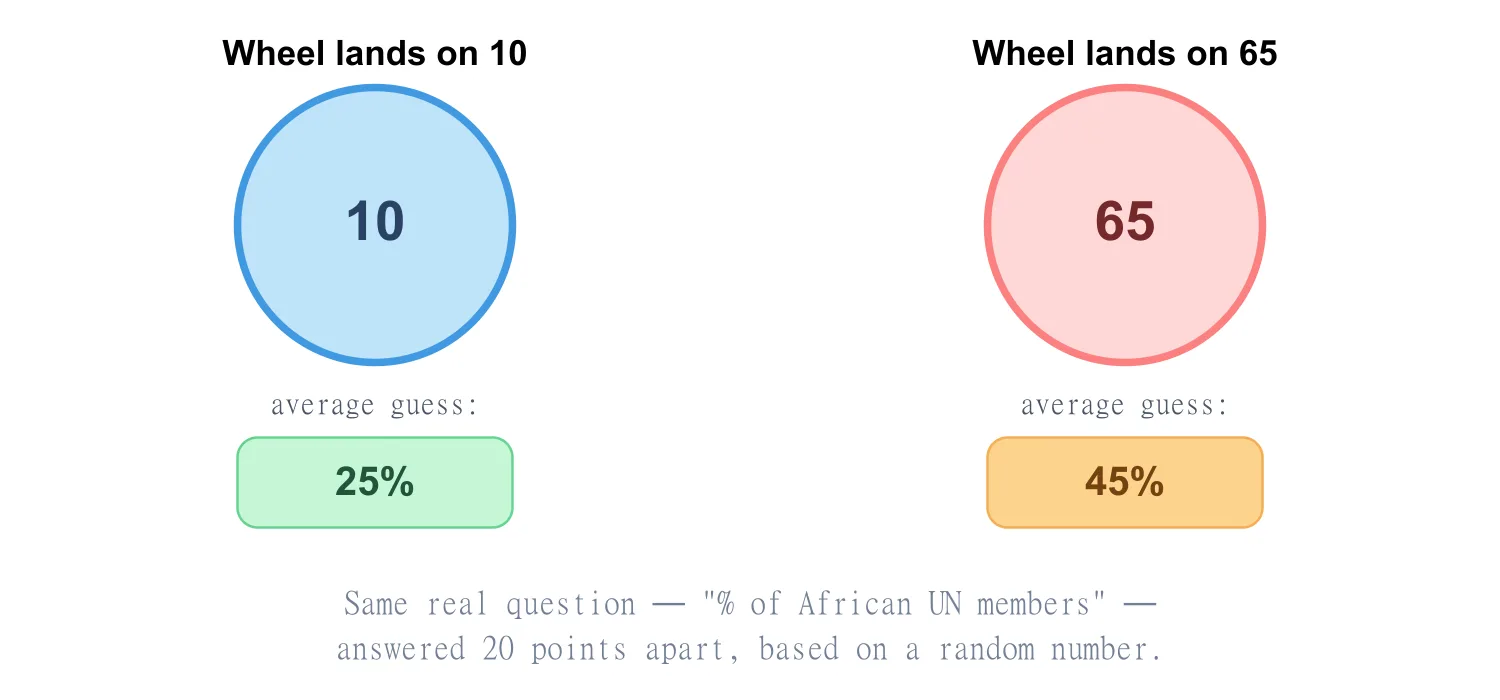
The definitive demonstration of anchoring comes from a 1974 experiment by psychologists Amos Tversky and Daniel Kahneman. They spun a wheel of fortune in front of participants — a wheel secretly rigged to stop on only one of two numbers: 10 or 65.
After the wheel stopped, participants were asked a completely unrelated question: what percentage of African countries are members of the United Nations? They were first asked whether the true percentage was higher or lower than the number the wheel landed on, then asked to give their actual best estimate.
The wheel’s number had nothing to do with the answer — it was random and participants knew it was random. And yet:
- Participants who saw the wheel land on 10 gave an average estimate of 25%.
- Participants who saw the wheel land on 65 gave an average estimate of 45%.
A meaningless spin of a wheel shifted people’s answers to a real factual question by a full 20 percentage points. This became one of the founding pieces of evidence in behavioral economics, and it’s the reason anchoring is treated as a fundamental — not a minor — flaw in human judgment.
A second anchoring bias experiment: the Social Security number auction
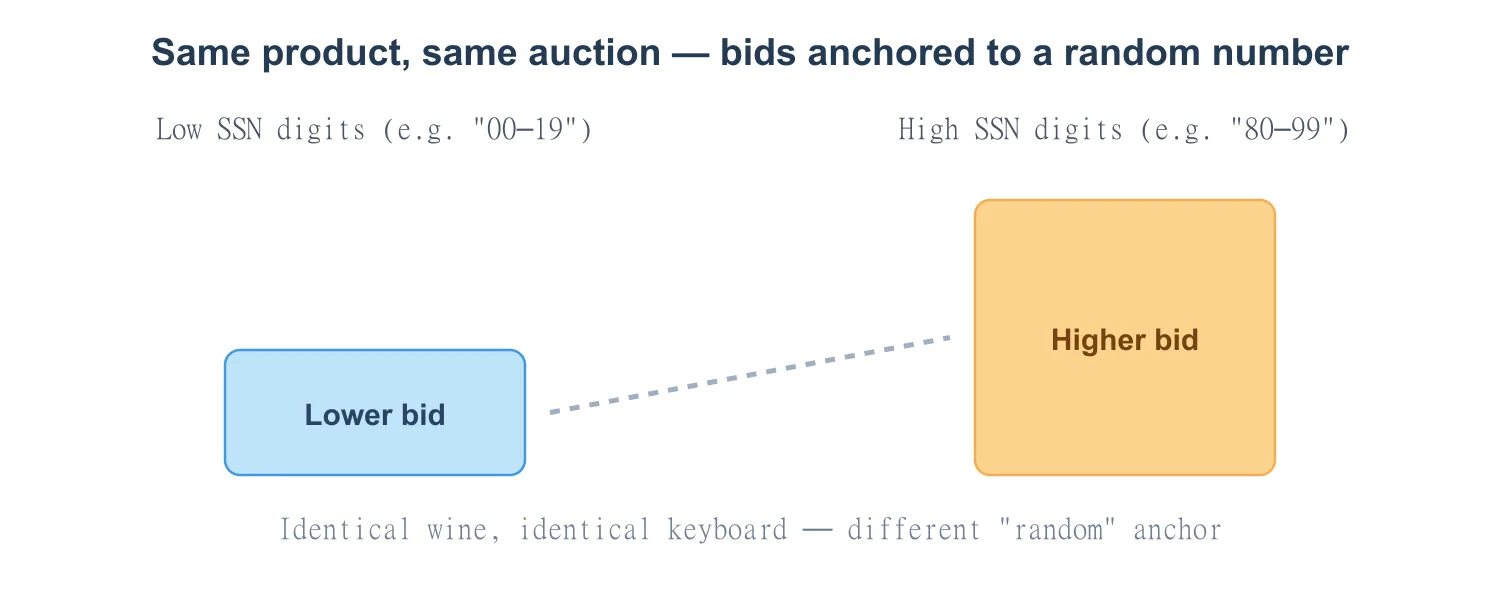
Three decades later, researchers Dan Ariely, George Loewenstein, and Drazen Prelec ran a 2003 study nicknamed “coherent arbitrariness” that made the same point with real money. MIT MBA students first wrote down the last two digits of their Social Security number. Then they were asked to bid in a real auction on ordinary products — wine, a cordless keyboard, and other everyday items.
Students happened to have SSN digits ranging anywhere from 00 to 99, entirely at random. And yet students whose last two digits fell in the highest range bid significantly more — in some cases multiple times more — than students whose digits fell in the lowest range, for the exact same products. A number with zero connection to the item’s value shaped how much real money people were willing to spend.
Anchoring vs. priming: what’s the difference?
These two get used almost interchangeably, but they describe different parts of the same process.
- Priming is the act of exposing someone to a stimulus — a number, word, or image — that influences how they process what comes next. Priming is the setup.
- Anchoring is what happens after: the specific effect where a number becomes a fixed reference point that subsequent judgments get pulled toward. Anchoring is the result.
In a negotiation, naming the first number is priming your counterpart. The fact that every offer afterward gets measured against that number is anchoring. They’re two names for two halves of the same move — you can’t set an anchor without priming first, and priming a number is only useful because anchoring makes it stick.
Anchoring bias vs. confirmation bias
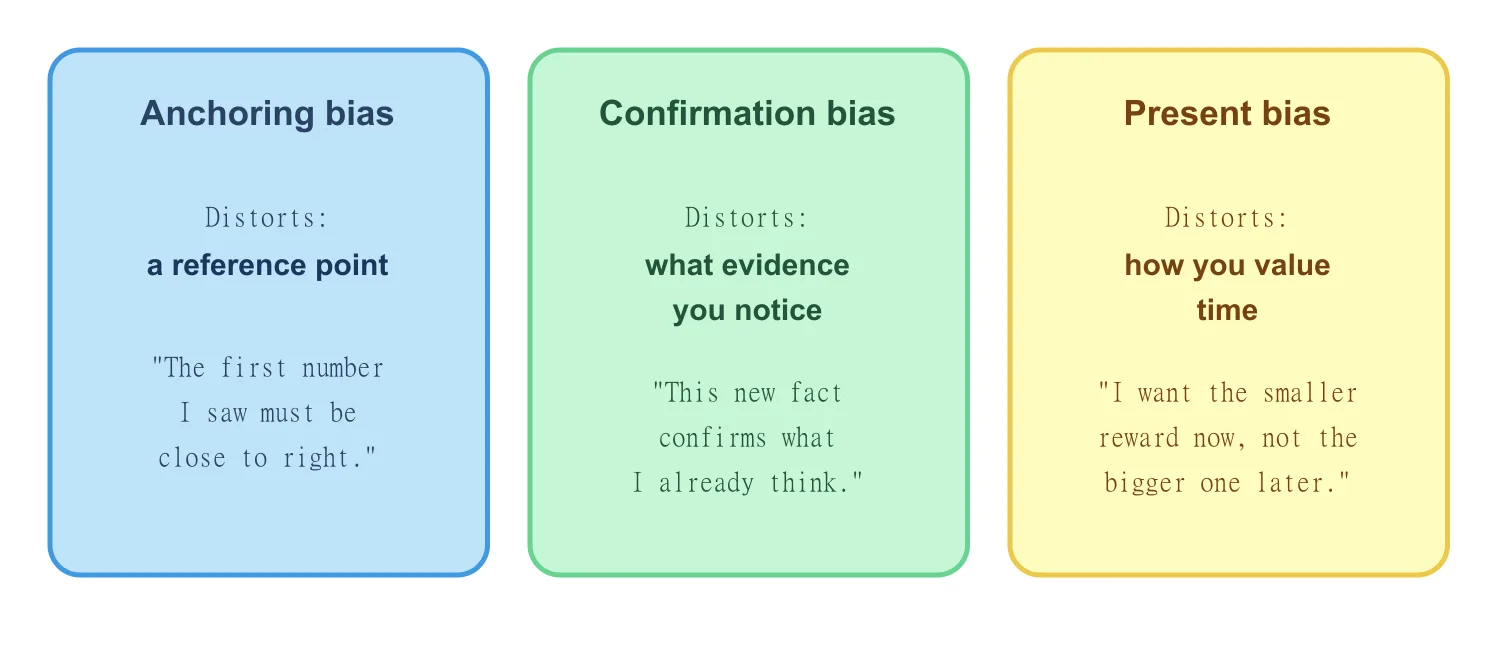
These two frequently show up together, which is exactly why they get confused. Anchoring bias sets a reference point — the first number or impression you land on. Confirmation bias is what happens next: once that reference point exists, you start noticing and favoring information that supports it, while discounting information that doesn’t. Anchoring plants the belief; confirmation bias defends it. In medicine, for example, a clinician anchors on an initial diagnosis, then confirmation bias kicks in as they interpret ambiguous symptoms as supporting that first guess rather than weighing them independently.
Anchoring bias vs. present bias
These sound related but describe entirely different mental shortcuts. Present bias (also called temporal discounting) is about time — the tendency to overvalue a smaller reward available now over a larger reward available later. Anchoring bias has nothing to do with timing at all; it’s about how a reference point — a number, price, or first impression — disproportionately shapes a judgment, regardless of when anything happens. You could anchor on a price and still be perfectly patient about payment timing, or show heavy present bias in a decision that has no anchor in it whatsoever. They’re separate biases that happen to both distort financial decisions.
Anchoring bias in negotiation and pricing
Nowhere is anchoring bias put to more deliberate use than in negotiation and retail pricing. Research from Harvard’s Program on Negotiation has found that the first offer in a negotiation can account for as much as 50% of the variance in the final agreed price — meaning whoever speaks first often has a lasting, outsized influence on where the deal lands, regardless of the item’s actual value.
Retailers use the same mechanism constantly:
- The crossed-out price. “$400 $180” anchors you to $400, making $180 feel like a bargain even if $180 was the item’s real value all along.
- The decoy tier. A deliberately overpriced “premium” option makes the mid-tier option look reasonably priced by comparison.
- The first number in a salary negotiation. Whoever names a figure first sets the range the rest of the conversation orbits around — which is why negotiation coaches almost universally advise naming your number first, anchored high but still credible.
Anchoring bias in decision making
Beyond negotiation and pricing specifically, anchoring quietly shapes decisions across almost every domain where a number or first impression comes before a judgment:
- Financial decisions: Investors often anchor to the price they originally paid for a stock, holding onto losing positions because they’re mentally comparing the current price to their purchase price rather than to the stock’s actual future prospects.
- Project estimates: Once a team commits to an initial timeline or budget estimate, later revisions tend to stay anchored near that original number even when new information suggests the real figure should be very different.
- Group decisions: In a meeting, the first number or opinion voiced — often by whoever speaks first or holds the most seniority — anchors the entire group’s discussion, even when it wasn’t intended as a final answer.
- Everyday choices: Even something as small as the first restaurant suggestion in a group chat tends to anchor the eventual decision, with later suggestions unconsciously evaluated against it.
Anchoring bias in medicine and healthcare
Anchoring bias has been studied extensively in clinical settings, where it carries real patient-safety consequences. Research on diagnostic reasoning has identified anchoring as the most common cognitive error in emergency medicine, and cognitive biases like anchoring have been linked to a substantial share of diagnostic errors overall.
The pattern in medicine follows a consistent shape: a clinician “locks onto” one or two salient early symptoms and forms a preliminary diagnosis, then interprets everything that follows through that lens rather than reassessing from scratch. This is where anchoring and confirmation bias compound each other — once the initial diagnosis is anchored, ambiguous new symptoms tend to get read as supporting it, while contradicting evidence gets explained away or under-weighted.
Medical educators now teach explicit debiasing strategies to counter this: deliberately generating a wider differential diagnosis before committing to one explanation, revisiting the working diagnosis whenever new symptoms don’t fit cleanly, and building in a structured “second look” at the case with fresh eyes — the clinical equivalent of the general overcoming strategies covered below.
Anchoring bias examples
Anchoring bias examples in real life
- Real estate: A house listed slightly above market value makes buyers perceive later, more reasonably priced homes as a great deal — even when the first house’s price was inflated on purpose.
- Job interviews: An interviewer who reads a glowing referral before meeting a candidate tends to interpret every answer more favorably than they would have otherwise.
- Restaurant menus: A $95 steak at the top of the menu makes the $38 option look like the reasonable choice, even if $38 is still expensive for that dish.
- Everyday shopping: Seeing “only 3 left, was $89” anchors you to $89 as the item’s “real” worth, making the current price feel urgent and discounted regardless of what it actually costs elsewhere.
- Dating and first impressions: A single striking detail from someone’s dating profile — a job title, a photo, a shared interest — becomes the lens the rest of the profile gets read through, for better or worse.
- Tipping: A checkout screen that suggests 18%, 20%, and 25% as tip options anchors your sense of a “normal” tip upward, compared to being asked to enter any amount freely.
Anchoring bias example in school
A teacher grading a stack of essays forms an impression from the first one or two papers — “this class did well” or “this class struggled” — and that early impression can anchor how generously or harshly later essays in the same stack get graded, even when the actual quality varies widely. The same effect shows up in standardized testing: a student who sees a difficult first question can anchor to “this test is hard,” approaching every subsequent question with lowered confidence regardless of its actual difficulty.
The psychology behind anchoring bias: why it’s so powerful
Anchoring works because of how the mind actually processes new numbers, not because people are careless. Kahneman’s own broader theory of judgment — laid out in Thinking, Fast and Slow — frames the mechanism as a conflict between two modes of thinking: System 1, fast and automatic, latches onto the first number it sees and treats it as a usable starting point; System 2, slow and effortful, is responsible for adjusting away from that starting point — but adjustment takes energy and attention that System 2 often doesn’t spend enough of. The anchor wins by default, not by force.
- Insufficient adjustment. Once a starting number is in mind, people do adjust away from it — just not enough. The final judgment stays biased toward the anchor even after conscious effort to correct for it.
- Cognitive ease. Anchoring is a mental shortcut that saves effort. Building an estimate from scratch takes real work; adjusting from a number you already have feels faster and easier.
- It works even when you know it’s happening. Tversky and Kahneman’s participants knew the wheel was random and still anchored to it. Awareness alone doesn’t neutralize the effect, which is what makes it so persistently useful in sales and negotiation.
How to overcome anchoring bias
- Get an independent estimate first. Before you see a price, quote, or offer, form your own number based on outside research — comparable listings, market rates, other quotes — so you have a real reference point instead of the one you’re handed.
- Actively argue against the anchor. Deliberately ask “why might this number be wrong or too high?” Research shows generating reasons against an anchor is one of the few techniques that measurably weakens its pull.
- Widen your comparison set. Look at several options or data points instead of anchoring on the first one you saw — a single number has power precisely because it’s the only one in view.
- Speak first when you can. In a negotiation, naming a well-researched number before the other party does puts you in control of the anchor instead of reacting to theirs.
- Slow down on high-stakes decisions. Anchoring exploits fast, automatic judgment. Deliberately pausing to reconsider gives your more careful reasoning a chance to catch up.
This connects directly to the broader critical thinking skill of evaluating evidence independently rather than accepting the first number you’re handed, and it pairs well with inversion thinking — asking what the number would look like if you’d never seen the anchor at all.
Frequently asked questions
What is anchoring bias in simple terms?
It’s relying too heavily on the first piece of information you see when making a judgment or estimate, even when that first number is arbitrary or has nothing to do with the actual answer.
What is the classic example of anchoring bias?
Tversky and Kahneman’s 1974 wheel-of-fortune study, where a rigged spin landing on 10 versus 65 shifted people’s estimates of an unrelated fact — the percentage of African UN member countries — from an average of 25% to 45%.
What’s the difference between anchoring and priming?
Priming is exposing someone to information that shapes how they interpret what comes next. Anchoring is the specific resulting effect where a number becomes a fixed reference point that later judgments get pulled toward. Priming sets up the anchor; anchoring is what the anchor then does.
How does anchoring bias affect negotiation?
The first number named in a negotiation can account for roughly half the variance in the final agreed price, according to Harvard negotiation research — whoever anchors first has a lasting pull on where the deal ultimately lands.
How can you overcome anchoring bias?
Form an independent estimate before seeing any offer or price, deliberately generate reasons the anchor number might be wrong, compare multiple options rather than just one, and when possible, name your own number first.
Does knowing about anchoring bias protect you from it?
Not entirely. In Tversky and Kahneman’s original study, participants knew the wheel spin was random and still anchored their estimates to it — awareness reduces the effect somewhat but doesn’t eliminate it.
What’s the difference between anchoring bias and confirmation bias?
Anchoring sets an initial reference point; confirmation bias is what happens afterward, as you favor information that supports that reference point while discounting evidence against it. Anchoring plants the belief, confirmation bias defends it.
What’s the difference between anchoring bias and present bias?
Present bias is about time — overvaluing a smaller reward now over a larger one later. Anchoring bias is about reference points shaping a judgment, with no connection to timing at all. They’re separate biases that can both distort the same decision.
How does anchoring bias affect medicine and healthcare?
Clinicians can lock onto an early diagnosis based on initial symptoms, then interpret later, ambiguous findings as confirming that diagnosis rather than reassessing from scratch. Research has identified anchoring as the most common cognitive error in emergency medicine, contributing to diagnostic mistakes.
What is an example of anchoring bias in a real experiment?
Besides Tversky and Kahneman’s wheel-of-fortune study, a 2003 experiment had MIT students bid on products after writing down the last two digits of their Social Security number — students with higher digits bid significantly more for identical products, despite the number being completely random.
Keep learning: the full list of cognitive biases, how confirmation bias reinforces first impressions, and the mental models that help counter both.