Sunk Cost Fallacy: Definition, Examples & How to Avoid It
Sunk Cost Fallacy: Definition, Examples & How to Avoid It
You’ve sat through forty minutes of a movie you’re not enjoying, thinking “I already paid for it, might as well finish.” That’s the sunk cost fallacy: letting money, time, or effort you can never get back talk you into pouring in more, long after it stopped making sense. It’s one of the best-documented biases in behavioral economics, named after a doomed supersonic jet — and, stranger still, most animals and small children turn out to be better at avoiding it than adult humans are.
On this page
What is the sunk cost fallacy?
The sunk cost fallacy is the tendency to keep investing time, money, or effort into something specifically because of what you’ve already put into it, rather than because it’s still the best use of your resources going forward. In economics, a sunk cost is money, time, or effort that’s already spent and can never be recovered no matter what you decide next — which means, rationally, it shouldn’t factor into the decision at all. The fallacy is treating it as though it should.
It’s one of the most heavily studied biases in behavioral economics, sitting alongside other cognitive biases like anchoring bias, the availability heuristic, and the halo effect as a case where the rational, forward-looking choice loses out to a backward-looking one.
As a discipline, the sunk cost fallacy sits right at the boundary between economics and psychology. In classical economic theory, a sunk cost is explicitly defined as irrelevant to future decisions — only prospective costs (money, time, or effort not yet spent) should factor into a rational choice, since sunk costs are gone regardless of what you decide next. The “fallacy” is the name for how consistently real people violate that rule.
Psychologically, the leading explanation is loss aversion — part of Kahneman and Tversky’s prospect theory, the finding that losses hurt roughly twice as much as an equivalent gain feels good. Walking away from a sunk cost registers as a loss, so people avoid it even when the numbers say they shouldn’t. Framing plays a role too: continuing lets a decision feel like “staying the course” rather than “admitting failure,” and social or reputational pressure — not wanting to be seen giving up — piles on top of both.
The original 1985 study
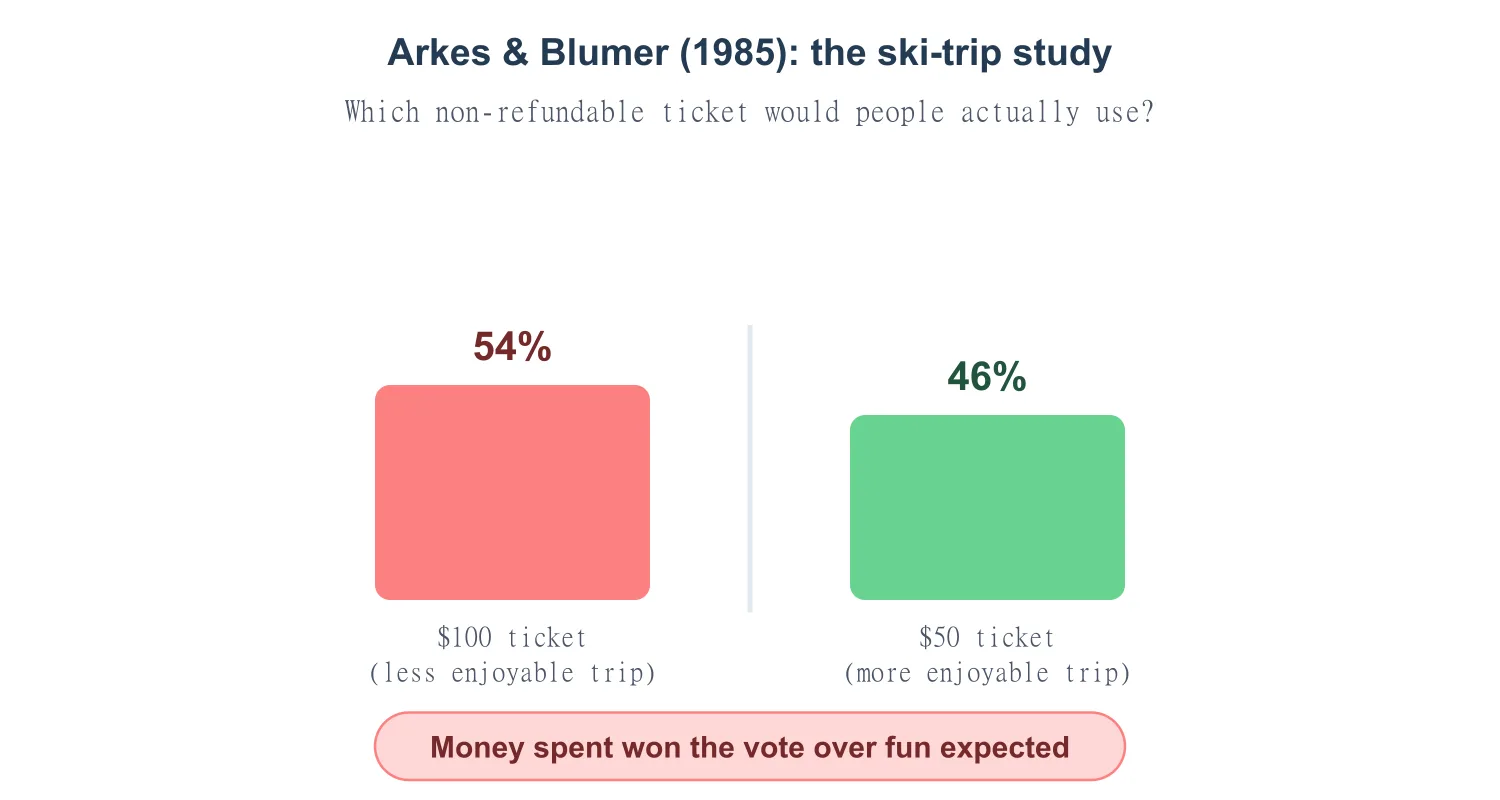
Psychologists Hal Arkes and Catherine Blumer ran the study that put the sunk cost fallacy on the map, in their 1985 paper “The Psychology of Sunk Cost.” They gave people a scenario: imagine you spent $100 on a nonrefundable ticket for a ski trip to Michigan. A little while later, you find a $50 ticket to a ski trip in Wisconsin that you’d actually enjoy more, and you buy that one too. Then you discover both trips fall on the same weekend — the tickets can’t be refunded or resold, and you can only use one.
Rationally, the $100 is gone either way, so the only thing that should matter is which trip you’d enjoy more. But 54% of participants said they’d use the $100 Michigan ticket — the trip they expected to enjoy less — simply because it cost more. Arkes and Blumer had demonstrated, cleanly, that people let unrecoverable past spending steer decisions that should only be about the future.
The Concorde twist: why animals and children mostly avoid it
The nickname “Concorde fallacy” comes from the British-French supersonic jet, which the two governments kept funding for years — an estimated $2.8 billion in total — even after it was clear the plane would never turn a profit. Concorde flew commercially from 1976 until its final flight in 2003, 27 years of pouring money into a project that was already a lost cause on paper.
But the name has a stranger origin than the plane itself. Biologist Richard Dawkins and his student Tamsin Carlisle coined “Concorde fallacy” in a 1976 Nature article about animals that seem to over-invest in a failing effort — defending a nest, say, well past the point it’s worth saving. The catch: when researchers went looking for it in animals, they mostly couldn’t find it. In a 1999 review, Hal Arkes and Peter Ayton concluded there are no unambiguous cases of the sunk cost fallacy in non-human animals — and, more surprisingly, that young children tend to make the economically correct call too, while older children and adults increasingly don’t.
Arkes and Ayton’s explanation: adult humans haven’t failed to learn a rule, they’ve overlearned one. Somewhere along the way, most people absorb a general “don’t waste what you’ve already spent” rule that’s a genuinely useful habit in daily life — and then misapply it to decisions where the spending is already gone and truly can’t be un-wasted. It’s a rare case of a bias that looks like a design flaw but is closer to a good rule applied one situation too far.
Sunk cost fallacy vs. escalation of commitment
These two terms describe the same failure from different angles, and they’re often used interchangeably — but they’re not quite the same thing.
- Sunk cost fallacy: the cognitive bias itself — the mental error of letting unrecoverable past costs influence a forward-looking decision.
- Escalation of commitment: the behavior that often follows — actually pouring more time, money, or resources into a failing course of action, frequently intensified by social or organizational pressure to avoid admitting a mistake.
In short, the sunk cost fallacy is the flawed reasoning; escalation of commitment is what that reasoning often leads people — and organizations — to actually do.
Sunk cost fallacy examples
Sunk cost fallacy examples in real life
- Finishing a bad meal: Cleaning your plate — or ordering an extra course — at an expensive restaurant just to “get your money’s worth,” even after you’re full.
- An unused gym membership: Renewing a subscription you never use because canceling would mean admitting the past year’s payments were wasted.
- Home renovations that keep growing: Approving another round of over-budget work because so much has already been spent that stopping now feels like throwing it all away.
- Sticking with a college major: Staying in a degree program you’ve lost interest in because switching would mean “losing” the credits and semesters already completed.
At work
A team keeps funding a product that clearly isn’t working because of how many months of development already went into it — the actual question, “is this still the best use of our remaining budget?”, never gets asked on its own terms.
In relationships
Someone stays in a relationship that no longer makes them happy because of how many years they’ve already invested, treating the relationship like an investment to protect rather than a present choice to make.
In gambling
A gambler who’s down for the night keeps betting to “win back” what’s already lost, even though every previous bet is gone regardless of what happens next — a pattern well known enough to have its own name, chasing losses.
In investing
An investor holds onto a stock that’s fallen well below what they paid, waiting to “at least break even” before selling, instead of judging the stock on what it’s likely to do from here.
How to avoid the sunk cost fallacy
- Ask the blank-slate question. If you’d never made the original investment, would you choose to start now, from scratch, given only what you know today?
- Separate the decision from the feeling of waste. The money, time, or effort is gone either way — no future choice can bring it back, so it isn’t a real input to weigh.
- Judge only the road ahead. The only numbers that should count are the costs and benefits still in front of you, not the ones already behind you.
- Watch for “don’t waste it” reasoning specifically. That instinct is usually a good one — the trap is applying it to costs that are already unrecoverable, where nothing is actually being saved by continuing.
- Get an outside opinion, the same habit that helps against confirmation bias — someone with no history in the decision won’t feel the pull of what’s already been spent.
This connects to the broader critical thinking skill of evaluating a decision by its future consequences alone, instead of by how much has already been poured into it.
Frequently asked questions
What is the sunk cost fallacy in simple terms?
It’s the tendency to keep going with something because of the time, money, or effort you’ve already put into it, even when that past investment can’t be recovered and shouldn’t affect what you do next.
Who came up with the sunk cost fallacy?
Psychologists Hal Arkes and Catherine Blumer formally documented it in their 1985 paper “The Psychology of Sunk Cost,” though the underlying economic idea of a “sunk cost” predates their research.
What is an example of the sunk cost fallacy?
Continuing to watch a movie you’re not enjoying because you already paid for the ticket is a classic, everyday example — the ticket price is gone either way, so it shouldn’t affect whether you keep watching.
What is the difference between the sunk cost fallacy and escalation of commitment?
The sunk cost fallacy is the cognitive bias — the flawed reasoning itself. Escalation of commitment is the resulting behavior: actually investing more resources into a failing course of action because of that reasoning.
Do animals experience the sunk cost fallacy?
Mostly not, based on the available research. A 1999 review by Arkes and Ayton found no unambiguous evidence of the sunk cost fallacy in non-human animals, and young children also tend to avoid it — it’s adult humans who consistently fall for it.
How do you avoid the sunk cost fallacy?
Ask what you’d choose if you were starting fresh today with no past investment, then judge the decision only by the costs and benefits still ahead of you — the money, time, or effort already spent can’t be recovered either way.
Is the sunk cost fallacy an economics concept or a psychology concept?
Both. “Sunk cost” itself is a term from economics and accounting, describing money that can’t be recovered. The “fallacy” part is a finding from psychology and behavioral economics — the discovery that people don’t actually treat sunk costs as irrelevant, the way classical economic theory says a rational decision-maker should.
Is there an opposite of the sunk cost fallacy?
Not one single named bias, but economists point to the same fix either way: judge a decision only by prospective costs — the money, time, or effort not yet spent — and ignore what’s already gone. Some researchers also describe a related “reverse” pattern, where people give up on things too easily specifically because they were cheap or effortless to get, undervaluing them for the opposite reason a sunk cost gets overvalued.
Keep learning: the full list of cognitive biases, how the halo effect distorts judgment in a related way, and the Dunning-Kruger effect for another case where confidence and accuracy pull apart.