Halo Effect: Definition, Examples & How to Avoid It
The best-looking candidate in the interview room often gets rated as the most competent one too — before they’ve said anything that actually demonstrates competence. That’s the halo effect: one strong impression, usually something superficial like appearance, spilling over to color judgments about traits that have nothing to do with it. It’s one of the oldest documented cognitive biases, first named in a 1920 study of army officers, and a stranger follow-up study decades later showed it can even change how a person’s voice sounds to you.
What is the halo effect?
The halo effect is a cognitive bias where one positive impression of a person, brand, or product — often something as superficial as physical appearance — spreads out and colors judgment of that same person, brand, or product’s completely unrelated qualities. If someone comes across as likeable or attractive, people unconsciously assume they’re also smarter, more competent, or more trustworthy, with zero actual evidence for any of it.
The term was coined by psychologist Edward Thorndike in 1920, making it one of the earliest cognitive biases ever formally documented — decades before Tversky and Kahneman’s work on judgment heuristics. It sits alongside other cognitive biases like anchoring bias, the availability heuristic, and the Dunning-Kruger effect as a shortcut the mind takes to avoid the harder work of judging each trait on its own.
As a field, the halo effect — sometimes called the halo bias — sits mainly in social psychology and industrial-organizational psychology, the study of how people form impressions of others and how those impressions distort real-world judgments like hiring, grading, and performance reviews. Students encounter it early: it’s a standard topic in AP Psychology, covered in both the social-psychology unit (impression formation and attribution) and the cognitive-psychology unit, right alongside the availability heuristic and belief perseverance as one of the classic thinking errors.
The original 1920 study
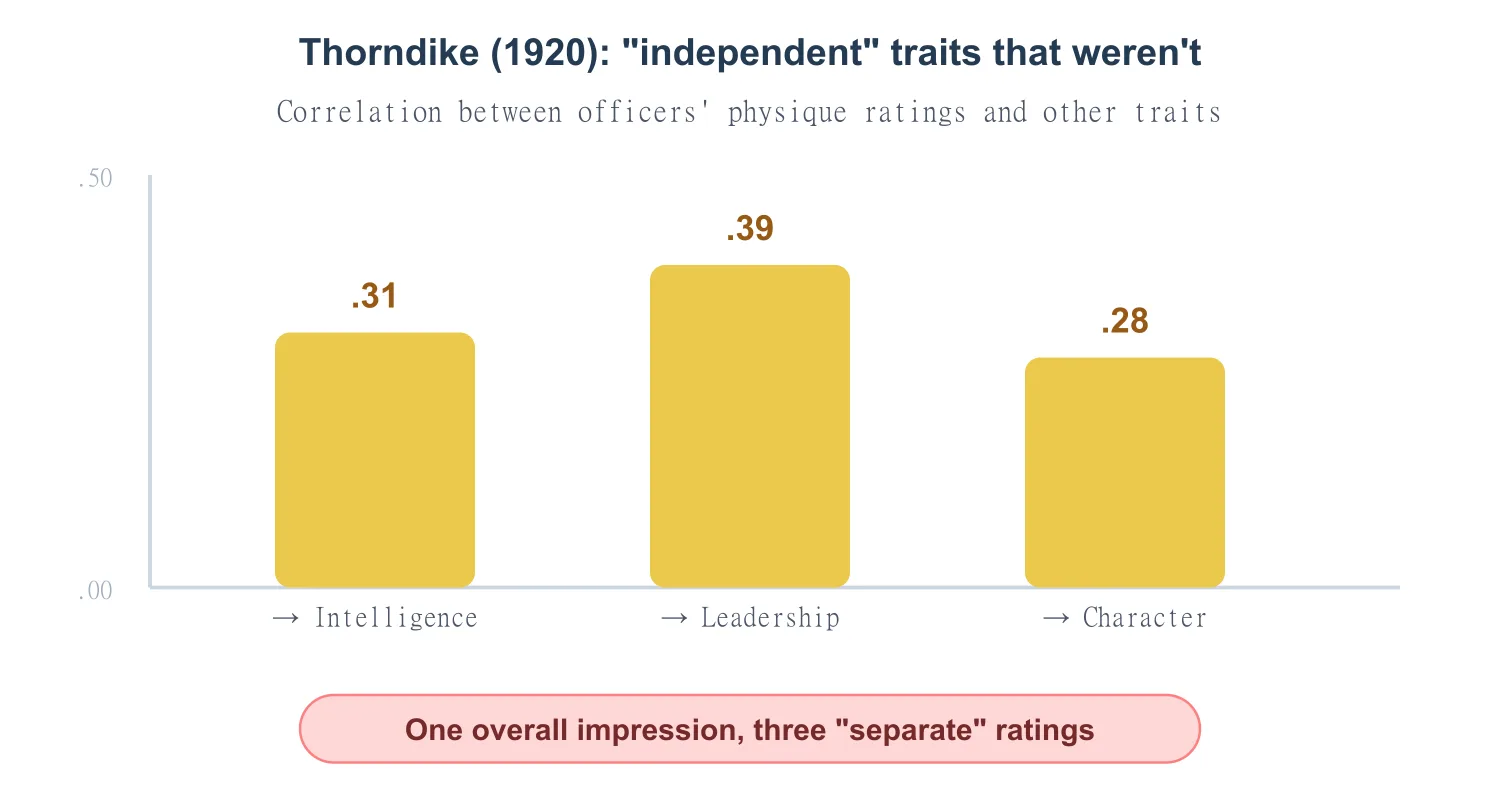
Thorndike’s foundational paper, “A Constant Error in Psychological Ratings,” analyzed how commanding officers rated their soldiers. Officers were asked to rate each soldier on a set of supposedly separate qualities — physique, intelligence, leadership, and character — often without ever having a real conversation with the men they were rating.
If the ratings were genuinely independent, a soldier’s physique score shouldn’t predict much about his intelligence score. Instead, Thorndike found the ratings were suspiciously tangled together: physique correlated with intelligence at roughly .31, with leadership at roughly .39, and with character at roughly .28 — far too high for traits that are supposed to have nothing to do with each other. Officers who formed one overall impression of a soldier — often starting with how he looked — let that impression bleed into every other rating they gave him.
The warm-instructor twist: changing how a voice sounds
Fifty-seven years later, researchers Richard Nisbett and Timothy Wilson ran a study showing the halo effect doesn’t just distort vague, hard-to-check traits like “character” — it can distort things a person can directly see and hear.
They showed 118 University of Michigan undergraduates one of two videotaped interviews with the same college instructor, a man who spoke English with a noticeable European accent. In one version he came across as warm and friendly; in the other, cold and distant. His physical appearance, mannerisms, and accent were identical in both tapes — the only real difference was his personality in the interview.
Afterward, participants rated how likeable the instructor was, and separately rated his appearance, mannerisms, and even his accent. Students who saw the warm version rated his appearance, mannerisms, and accent as appealing. Students who saw the exact same cold version rated those same physical attributes as irritating. Nisbett and Wilson’s conclusion is right there in their paper’s title: “unconscious alteration of judgments.” People didn’t just like the warm instructor more — they perceived his voice differently.
Halo effect vs. horn effect
The halo effect has a mirror image, and it’s worth knowing both directions.
- Halo effect: one positive impression spreads and inflates judgment of unrelated qualities.
- Horn effect (also called the reverse halo effect): one negative impression spreads and drags down judgment of unrelated qualities.
Both run on the same mechanism — a single trait standing in for a whole-person judgment — they just point in opposite directions.
Halo effect examples
Halo effect examples in real life
- The attractiveness stereotype: In a landmark 1972 study, researchers Karen Dion, Ellen Berscheid, and Elaine Walster had 60 University of Minnesota students rate photographs of attractive, average, and unattractive people across dozens of personality traits. Attractive people were consistently rated as more sociable, warm, and competent, and expected to land more prestigious careers — traits nobody could actually see in a photograph.
- The “health halo” at fast-food chains: A 2007 study by Pierre Chandon and Brian Wansink found that diners at Subway — a chain that markets itself as the healthy option — underestimated their meal’s calories by roughly 20–25% more than diners at McDonald’s, and were more likely to add a high-calorie side or drink, because the restaurant’s overall “healthy” halo made every item on the menu feel virtuous by association.
- The Apple/iPod effect: The runaway popularity of the iPod is widely credited with generating enthusiasm for other, unrelated Apple products — the halo effect turning goodwill toward one product into goodwill toward an entire brand.
- Attractive defendants: Mock-juror studies have found that attractive defendants tend to receive more lenient sentences than unattractive defendants for identical crimes, even though physical appearance has nothing to do with guilt.
At work
An employee who has one standout quarter is often assumed to be strong across the board — a great communicator, a natural leader — even in areas no one has actually evaluated yet.
In the classroom
In one study, the same essay scored 6.7 out of 10 when readers believed it was written by an attractive author, but only 5.9 when they believed the author was unattractive — for the exact same piece of writing.
In the courtroom
Researchers have found that mock jurors hand down more lenient sentences to attractive defendants than unattractive ones for identical offenses — evidence that the halo effect can sway judgments meant to rest purely on facts.
In marketing
Brands lean on the halo effect deliberately: a beloved flagship product lends its shine to an entire lineup, a celebrity endorsement transfers the celebrity’s likability to a product they’ve never used, and a single word like “organic” or “natural” on a label makes shoppers assume the whole product is healthier than it actually is.
In business
Business writer Phil Rosenzweig’s 2007 book The Halo Effect argues this bias quietly runs through corporate storytelling: when a company’s stock and sales are climbing, people credit its “visionary” leadership and “brilliant” culture — and when the same company’s numbers fall, that exact same leadership and culture suddenly get blamed, even though the underlying decisions may not have changed at all.
In relationships
In dating, an attractive or charming first impression tends to make a new partner seem kinder, smarter, and more trustworthy than the evidence actually supports — research on online dating profiles has found the same pattern, with more attractive profiles rated higher on unrelated personality traits too. It’s part of why early relationship “chemistry” can feel like it guarantees long-term compatibility, when the two aren’t actually linked.
In communication
A speaker who comes across as confident and polished is often judged as more credible and correct — regardless of what they actually said — because audiences unconsciously fold delivery into their assessment of the message’s substance. It’s one reason public speaking coaches treat delivery and content as separate skills to train.
How to avoid the halo effect
- Rate one trait at a time. Evaluate specific, unrelated qualities separately instead of forming one overall impression and letting it answer every question.
- Use structured or blind evaluation where you can. Removing photos, names, or first impressions from early-stage hiring or grading limits how much a superficial trait can leak into the rest of the assessment.
- Ask what evidence you actually have. If you can’t point to a specific reason you believe someone is competent, trustworthy, or skilled, you may be borrowing that judgment from an unrelated impression.
- Watch for the horn effect running in reverse. The same fix applies whether one bad trait is dragging everything down or one good trait is propping everything up.
- Actively look for disconfirming evidence, the same habit that helps against confirmation bias — deliberately ask “what do I actually know about this specific trait?” before trusting the overall glow.
This connects to the broader critical thinking skill of separating a general impression from the specific evidence that should actually support each individual judgment.
Frequently asked questions
What is the halo effect in simple terms?
It’s the tendency for one positive impression of a person or thing — often something superficial like appearance — to spread and make you assume other, unrelated qualities are also positive, without any real evidence.
Who coined the term “halo effect”?
Psychologist Edward Thorndike coined it in his 1920 paper “A Constant Error in Psychological Ratings,” based on a study of army officers rating soldiers on unrelated traits.
What is an example of the halo effect?
Rating a well-dressed, confident job candidate as more technically competent than an equally qualified but less polished candidate, based purely on the impression they made, is a classic example.
What is the difference between the halo effect and the horn effect?
The halo effect is when one positive trait inflates judgment of unrelated qualities. The horn effect (or reverse halo effect) is the same mechanism working in the opposite direction — one negative trait drags down judgment of everything else.
How do you avoid the halo effect?
Evaluate specific traits one at a time instead of forming a single overall impression, use blind or structured evaluation where possible, and ask what concrete evidence actually supports each individual judgment.
Does the halo effect only apply to physical attractiveness?
No — attractiveness is the most-studied trigger, but any strong first impression can start it, including warmth, confidence, a brand’s reputation, or even a single well-known product, as the Nisbett and Wilson study and the Apple/iPod example both show.
Is the halo effect covered on the AP Psychology exam?
Yes. It appears in both the social psychology unit (under impression formation and attribution) and the cognitive psychology unit, alongside other classic thinking errors like the availability heuristic and belief perseverance.
How does the halo effect affect research?
It’s a well-known threat to validity in ratings-based research: a rater’s overall impression of a subject — a job candidate, a piece of writing, a study participant — can bleed into every score they give, even on dimensions meant to be judged independently. Performance appraisals and subjective grading are especially vulnerable, which is why blind or structured evaluation is often recommended as a fix.
Does the halo effect happen in healthcare?
Yes. A patient’s likability or appearance can unconsciously color a clinician’s judgment of unrelated things, including how serious their symptoms seem — one reason structured checklists and standardized assessments are used to keep diagnosis focused on evidence rather than impression.
Does “halo effect” also refer to circles of light around lights?
Yes, but it’s a completely different, unrelated phenomenon — an optical effect where light diffracts or scatters (from cataracts, glaucoma, astigmatism, or ice crystals in the atmosphere) and creates a visible ring around a light source. That’s a vision or optics topic, not the cognitive bias covered on this page.
Keep learning: the full list of cognitive biases, how the availability heuristic distorts judgment in a related way, and the Dunning-Kruger effect for another case where confidence and accuracy pull apart.