Dunning-Kruger Effect: Definition, Examples & How to Avoid It
Dunning-Kruger Effect: Definition, Examples & How to Avoid It
The person most confident in the room is often the least equipped to have an opinion — and doesn’t know it. That’s the Dunning-Kruger effect in one sentence, and it’s become one of the most quoted findings in psychology, shared constantly as a way to explain overconfident coworkers, internet arguments, and bad advice from people who should know better. It’s also more contested among researchers than most popular explanations let on, which makes it worth understanding properly instead of just repeating the meme version.
- What is the Dunning-Kruger effect?
- Origin: the lemon juice bank robber
- The original 1999 study: the exact numbers
- The graph: the truth about “Mount Stupid”
- Is the Dunning-Kruger effect real?
- Has it been debunked?
- What’s the opposite?
- Dunning-Kruger vs. impostor syndrome
- Dunning-Kruger effect examples
- How to avoid it
- FAQ
What is the Dunning-Kruger effect?
The Dunning-Kruger effect describes a pattern where people with low ability or knowledge in a specific area tend to overestimate their own competence, because the same lack of skill that causes poor performance also prevents them from recognizing it. It’s sometimes called a “double curse”: you’re not just bad at the task, you’re also bad at judging how bad you are at it.
It’s named after psychologists David Dunning and Justin Kruger, whose 1999 study gave the effect its name. It sits in our cognitive biases guide alongside anchoring bias and confirmation bias as one of the mental patterns that distort self-assessment specifically, rather than judgment about the outside world.
Dunning-Kruger effect origin: the lemon juice bank robber
In January 1995, a Pittsburgh man named McArthur Wheeler robbed two banks in broad daylight with his face coated in lemon juice — no mask, no other disguise. He’d apparently heard that lemon juice works as invisible ink and reasoned that rubbing it on his skin would make his face invisible to security cameras too. Police released the surveillance footage to local news, and Wheeler was recognized and arrested that April. Shown the tape as evidence, he reportedly reacted with genuine confusion: “But I wore the juice.”
Psychologist David Dunning read about the case and got curious about a specific flavor of confidence — not just being wrong, but being completely unequipped to recognize it. Working with then-graduate-student Justin Kruger, he designed a study to test whether people who perform poorly at a skill are also poor at judging their own performance at it. The result was the 1999 paper “Unskilled and Unaware of It,” published in the Journal of Personality and Social Psychology — the study that gave the effect its name.
The original 1999 study: the exact numbers
Dunning and Kruger’s research, published in the Journal of Personality and Social Psychology, ran participants through tests of humor, logical reasoning, and grammar, then asked each person to estimate how well they’d performed compared to everyone else.
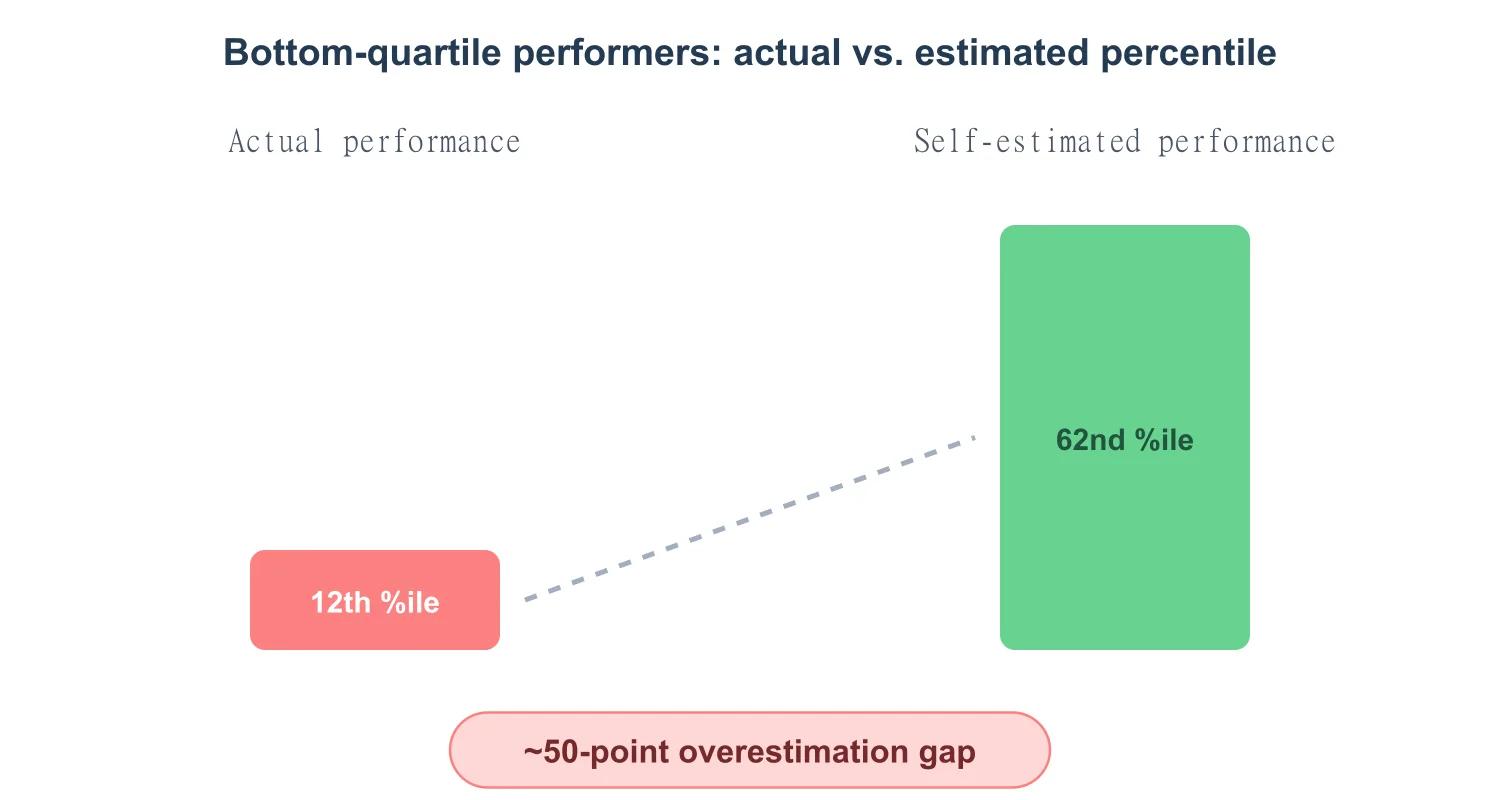
The headline result came from the bottom-scoring group. Participants who actually scored in the bottom quartile — meaning their real performance put them around the 12th percentile — estimated, on average, that they’d scored around the 62nd percentile. That’s a gap of roughly 50 percentile points between how these participants actually performed and how well they believed they’d performed.
Meanwhile, the highest performers showed the opposite pattern, though far less dramatically: top scorers slightly underestimated their relative standing, partly because they assumed tasks that felt easy to them must also feel easy to everyone else — a related pattern sometimes called the curse of knowledge.
The Dunning-Kruger effect graph: the truth about “Mount Stupid”
Search for the Dunning-Kruger effect and you’ll almost certainly run into the same image: a hump-shaped curve running from a “Peak of Mount Stupid,” down through a “Valley of Despair,” up a “Slope of Enlightenment,” to a “Plateau of Sustainability.” It’s everywhere — training slides, LinkedIn posts, textbook sidebars. There’s just one problem: that curve never appeared in Dunning and Kruger’s 1999 paper. Neither of them plotted it, named it, or claimed it.
What the original study actually produced looks like the chart above — bar-style comparisons of actual versus self-estimated percentile rank across four quartiles, not a smooth confidence-over-time curve. The “Mount Stupid” version is a later popularization, useful as a rough teaching sketch of how confidence can outpace skill early on and correct itself with experience, but it’s not a chart of real data. Treating it as one is part of what’s fed the pushback covered next.
Is the Dunning-Kruger effect real? The statistical-artifact controversy
Here’s the part almost never mentioned outside academic circles: several researchers have argued that a meaningful chunk of the classic Dunning-Kruger pattern is a statistical artifact rather than a pure psychological phenomenon.
Edward Nuhfer and colleagues (2016, 2017) argued that two statistical effects inflate the pattern: regression to the mean (extreme scores naturally drift toward average on repeated measurement) and autocorrelation — a subtle issue that arises specifically because the original method sorts people into quartiles using the same performance score it then compares against their self-estimate, which can manufacture part of the “curse” mathematically.
In 2020, Gilles Gignac and Marcin Zajenkowski tested this using continuous-variable statistical methods instead of the original quartile-based grouping. They found the relationship between actual ability and self-assessed ability was closer to a modest, roughly linear correlation — real, but far less dramatic than the steep, iconic curve usually shown in explainer graphics.
The current picture researchers generally agree on: the extreme version of the effect — the very worst performers being wildly, almost comically overconfident — is likely overstated by the original quartile method. But the broader, less flashy finding underneath it holds up fine: people are generally not very good at judging their own competence, especially in areas where they have the least experience to judge it against.
Has the Dunning-Kruger effect been debunked?
“Debunked” overstates it, but the pushback is more concrete than a vague academic disagreement — it comes with its own numbers. Researcher Edward Nuhfer, working with Eric Gaze and colleagues, tested self-assessment differently than the original study: instead of sorting people into quartiles and comparing group averages, they gave students a 25-question scientific literacy test and had them rate their confidence on each individual question as “nailed it,” “not sure,” or “no idea.”
Measured that way, the bottom-scoring students weren’t nearly as deluded as the classic version suggests: only about 16.5% significantly overestimated their ability, while roughly 3.9% significantly underestimated it — meaning nearly 80% of the weakest performers judged themselves reasonably accurately. Nuhfer’s team also ran the original quartile-based method on randomly generated data — no real test-takers at all — and got the same “unskilled and unaware” pattern out of pure statistical noise, reinforcing the argument that the classic method can manufacture the effect’s signature shape on its own.
The honest summary: the dramatic pop-psychology version — the bottom quartile being wildly, almost comically overconfident — doesn’t hold up well under closer measurement. The narrower, better-supported finding — that self-assessment is generally noisy and only loosely tied to actual ability — survives the criticism intact.
What’s the opposite of the Dunning-Kruger effect?
Two different answers get called the “opposite” of the Dunning-Kruger effect, and they’re worth telling apart.
The first sits inside Dunning and Kruger’s own data: their highest-scoring participants slightly underestimated how they’d ranked against everyone else — the curse of knowledge pattern mentioned earlier. That’s the literal statistical mirror image: high ability paired with modest, sometimes too-modest confidence, instead of low ability paired with excess confidence.
The second, more commonly cited “opposite” is impostor syndrome — a separate, well-documented pattern where genuinely skilled people persistently doubt their abilities and credit their success to luck rather than competence. It isn’t from the same research and isn’t measured the same way, but it matches the popular idea of an “opposite” well enough that the two get compared constantly. Here’s exactly how they differ.
Dunning-Kruger effect vs. impostor syndrome
These two get paired constantly because they look like mirror images of each other — and in a loose sense, they are.
- Dunning-Kruger effect: low competence paired with high, unwarranted confidence. The person doesn’t have enough knowledge to see their own gaps.
- Impostor syndrome: high competence paired with persistent self-doubt. The person has real skill but can’t internalize evidence of it, often attributing success to luck.
They’re not actually two ends of one continuous scale — they’re separate psychological patterns that happen to sit on opposite sides of the confidence-competence relationship. It’s entirely possible to have neither, or in some documented cases, to experience both at different times in the same field as skill develops.
Dunning-Kruger effect examples
- At work: A new hire who’s completed one training module confidently corrects a colleague with a decade of experience, unaware of how much the module didn’t cover.
- Online debates: Someone who read a single article on a complex scientific topic argues with confidence against researchers who’ve spent careers studying it.
- Driving and skill self-ratings: Surveys consistently find that a large majority of drivers rate themselves as “above average” — a statistical impossibility if taken literally, and a classic sign of miscalibrated self-assessment.
- Learning an instrument or sport: Early beginners often feel closer to competent than they are, before enough exposure teaches them what real skill actually looks like.
- Management and hiring: A candidate who oversells a skill they’ve barely used isn’t necessarily lying — they may genuinely not know enough about the skill to gauge their own limits.
How to avoid the Dunning-Kruger effect
- Seek outside feedback deliberately, especially from people more experienced than you — self-assessment is exactly the tool this effect breaks.
- Treat early confidence as a signal to check, not celebrate. Feeling like you’ve “got it” quickly is sometimes a sign you haven’t yet learned enough to see what you’re missing.
- Study the field’s actual difficulty before judging your own skill. A quick look at genuine experts’ work resets your sense of the real bar.
- Build a habit of asking “what would prove me wrong here?” — the same self-regulation move that helps against confirmation bias.
- Keep a track record. A simple log of predictions and outcomes confronts you with your actual calibration over time, rather than your in-the-moment sense of confidence.
This connects to the broader critical thinking skill of self-regulation — monitoring your own reasoning rather than assuming your first impression of your own ability is accurate.
Frequently asked questions
What is the Dunning-Kruger effect in simple terms?
It’s the pattern where people who know or can do the least in a specific area tend to overestimate their competence, because the same lack of knowledge that causes poor performance also prevents them from recognizing it.
What was the original Dunning-Kruger study?
A 1999 study by David Dunning and Justin Kruger tested participants on humor, logic, and grammar, then compared their actual scores to their self-estimated percentile. Bottom-quartile scorers, who actually performed around the 12th percentile, estimated themselves at around the 62nd percentile.
Is the Dunning-Kruger effect actually real?
The broad finding — that people are often poor at judging their own competence — is well supported. However, researchers including Nuhfer and colleagues, and later Gignac and Zajenkowski, have shown that the extreme, dramatic version of the effect is partly inflated by statistical artifacts in the original quartile-based method, and is more modest when tested with continuous statistical models.
What’s the difference between Dunning-Kruger effect and impostor syndrome?
Dunning-Kruger involves low actual competence paired with high, unwarranted confidence. Impostor syndrome is the reverse: real competence paired with persistent self-doubt. They’re separate patterns, not opposite ends of a single scale.
How do you avoid the Dunning-Kruger effect?
Seek feedback from people more experienced than you, treat quick confidence as a signal to double-check rather than trust, study what real expertise in the field actually looks like, and keep a track record of your predictions versus outcomes.
What is an example of the Dunning-Kruger effect?
Surveys repeatedly find that most drivers rate their own driving as “above average” — a statistical impossibility if everyone believes it, and a well-known real-world illustration of miscalibrated self-assessment.
What is the origin of the Dunning-Kruger effect?
It traces back to a 1995 Pittsburgh bank robbery: McArthur Wheeler robbed two banks with his face coated in lemon juice, believing it would make him invisible to security cameras. Psychologist David Dunning read about the case and, with Justin Kruger, designed the 1999 study that gave the effect its name.
Is the famous Dunning-Kruger “Mount Stupid” graph real?
No. The hump-shaped curve showing a “Peak of Mount Stupid” and “Valley of Despair” is a popular illustration that never appeared in Dunning and Kruger’s 1999 paper. The actual study used bar-style comparisons of actual versus self-estimated percentile rank, not a confidence-over-time curve.
Has the Dunning-Kruger effect been debunked?
Not entirely, but it’s been significantly narrowed. Researchers Edward Nuhfer and Eric Gaze found that when self-assessment is measured question-by-question rather than by quartile averages, only about 16.5% of low-scoring students significantly overestimated their ability. The extreme, dramatic version of the effect is overstated; the broader finding that self-assessment is generally noisy still holds.
What is the opposite of the Dunning-Kruger effect?
Within the original study itself, the opposite pattern is high performers slightly underestimating their relative standing — sometimes called the curse of knowledge. In popular usage, impostor syndrome is more commonly cited as the opposite: real competence paired with persistent self-doubt.
Keep learning: the full list of cognitive biases, how anchoring bias distorts judgment from a different angle, and the critical thinking skills that help you self-assess more accurately.